The Teacher Evaluation Landscape in Missouri (TEL-MO)

May 21, 2026·
Tuan D. Nguyen, Ph.D.
Yujia Liu, Ph.D.
Yujia Liu, Ph.D.
Cory Koedel, Ph.D.
Cory Koedel, Ph.D.
· 2 min read
projects

ERRE Report · May 2026 Authors: Tuan D. Nguyen, Yujia Liu, & Cory Koedel Educator Recruitment, Retention, and Effectiveness (ERRE) Center, University of Missouri

This report presents a landscape analysis of teacher evaluation models used across Missouri school districts during the post-COVID period from the 2022–23 through 2024–25 school years. It offers a descriptive overview of the evaluation models, examines their geographic distribution, and explores variation across districts operating in different contexts. The analysis draws primarily on the annual Educator Evaluation Survey administered by the Missouri Department of Elementary and Secondary Education.

Key Findings

  • Seven different teacher evaluation models are in use in Missouri districts, but four models account for nearly all adoptions.
  • The NEE model is the most widely used model, especially in small and rural districts.
  • City and suburban districts draw on a more diverse mix of evaluation models.
  • Most evaluation models divide teachers into four or seven performance rating categories.
  • Teachers are rated “effective” at consistently high levels under every model.
  • Suburban districts report the highest average share of teachers rated effective; city districts report the lowest.

Performance Rating Levels

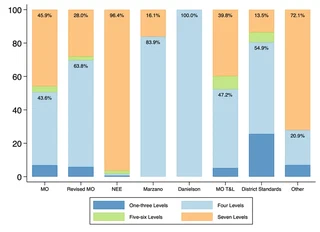
Most evaluation models use either four or seven rating categories. The NEE model employs a scale with seven categories (about 96 percent). At the opposite extreme, the Danielson model uses a four-level scale across all adopting schools. The Marzano model, the Revised MO model, and district-developed standards also lean heavily toward four levels, with roughly two-thirds to four-fifths of their schools adopting that structure. The MO model and the MO T&L model split almost evenly between four and seven levels.
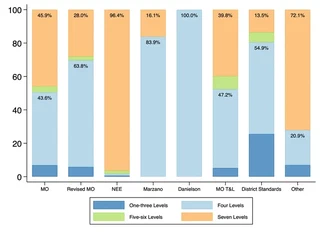
Figure 2.1. Distribution of Performance Rating Levels by Teacher Evaluation Model (2024–25)

Figure 2.1. Distribution of Performance Rating Levels by Teacher Evaluation Model (2024–25)

Download

⬇ Download Full Report (PDF)

⬇ Download Research Brief (PDF) — a shorter summary of this report’s findings.

Tuan D. Nguyen, Ph.D.
Authors
Principal Investigator
Tuan D. Nguyen, Ph.D., is a Mizzou Forward Associate Professor in the Department of Educational Leadership and Policy Analysis at the University of Missouri. He serves as Principal Investigator of the Educator Recruitment, Retention, and Effectiveness Center. His research focuses on education policy, the economics of education, teacher labor markets, rural education as well as STEM and special education, with particular expertise in causal inference and meta-analysis. Tuan has secured over $8.6 million in extramural funding as PI or co-PI, including an NSF CAREER Award examining the supply, qualifications, and career paths of STEM teachers. He has published widely in leading journals such as the American Educational Research Journal, Educational Evaluation and Policy Analysis, Educational Researcher, Review of Educational Research, AERA Open, and Economics of Education Review, including highly cited work on teacher shortages, turnover, and the rural teacher workforce. His scholarship has shaped national policy conversations, with contributions to the Economic Report of the President, testimony before the U.S. Commission on Civil Rights, and frequent media coverage in outlets including the New York Times, Washington Post, NPR, and Education Week. He also maintains widely used public resources, including www.teachershortages.com and the Community Assets and Relative Rurality (CARR) index, www.ruralityindex.com.
Yujia Liu, Ph.D.
Authors
Postdoctoral Fellow
Yujia Liu, Ph.D., is a Postdoctoral Fellow in the College of Education and Human Development at the University of Missouri, where she contributes quantitative and policy-analytic expertise to ERRE. She earned her Ph.D. in Education with a specialization in Education Policy and Social Context from the University of California, Irvine, and holds an M.Ed. in International Education Policy and Management from Vanderbilt University’s Peabody College. Her research interests span education policy, teacher labor markets, causal inference, and rural education, with a portfolio of publications in leading outlets such as the Journal of Research in Science Teaching, The Internet and Higher Education, and Computers & Education. Her recent work examines STEM teacher characteristics and mobility in the American Midwest, the rural teacher workforce using a novel rurality measure, teacher mentoring and retention, and the effects of base salary increases on teacher labor supply. Yujia brings strong methodological skills in quantitative research and causal inference, along with experience analyzing large-scale administrative data on educators, positioning her to play a central role in ERRE’s labor market research and statewide educator survey work.
Cory Koedel, Ph.D.
Authors
Co-Principal Investigator
Cory Koedel, Ph.D., is the Middlebush Chair in Economics and Professor of Economics and Public Policy at the University of Missouri. He is a Co-PI on the ERRE Center. His research focuses on teacher labor markets, teacher evaluation, and educator compensation, with a strong methodological grounding in applied econometrics and causal inference. Cory has served on numerous influential technical advisory bodies, including the Growth Model Technical Advisory Committee for MO DESE, the Technical Advisory Group for the National Council on Teacher Quality, and the REL Central Governing Board. He has held editorial leadership roles at multiple top journals, including as former Coeditor of Economics of Education Review and current editorial board member at Educational Evaluation and Policy Analysis, Education Finance and Policy, Research in Higher Education, and the Journal of Research on Educational Effectiveness. As PI or Co-PI on grants from the IES, NSF, and several foundations, Cory has supported a broad research agenda on teacher evaluations and labor markets. He has an extensive publication record in leading journals such as the American Economic Journal: Applied Economics, Journal of Policy Analysis and Management, American Educational Research Journal, Educational Evaluation and Policy Analysis, and Educational Researcher.